PPWR 50% Empty Space Rule: What Businesses Must Know
Does filling an oversized shipping box with paper or bubble wrap make it PPWR compliant? Not necessarily. Article 24 introduces a 50% empty-space limit for grouped, transport and e-commerce packaging, while separate rules apply to sales packaging. Learn how the requirements work, when they apply and what businesses should prepare.
PPWR's 50% Empty Space Rule: Why Filling the Box Won't Make It Compliant
Imagine ordering a small skincare product online.
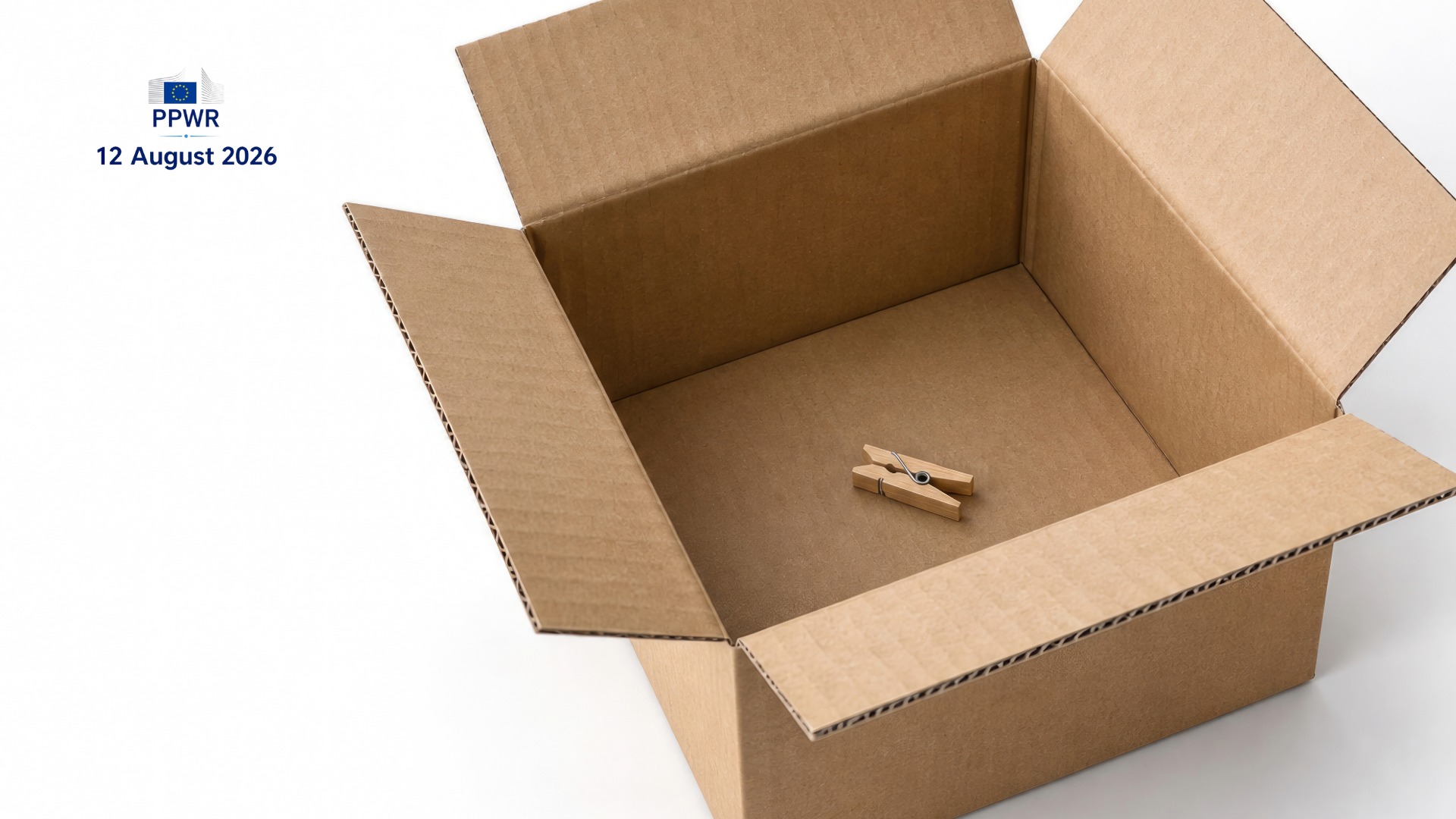
It arrives in a cardboard box several times larger than the product itself, surrounded by crumpled paper or inflated plastic cushions.
The product arrives safely. The box is recyclable. The packaging looks reasonably protective.
But does that mean it will meet the EU's new packaging rules?
Not necessarily.
Under the EU Packaging and Packaging Waste Regulation (PPWR), Regulation (EU) 2025/40, businesses will face specific restrictions on excessive packaging.
One of the most important is the maximum 50% empty-space ratio established by Article 24 for certain types of packaging.
And there is an important detail businesses should understand:
Adding filling material does not eliminate empty space under the PPWR calculation.
For e-commerce companies, retailers, fulfilment providers, manufacturers and packaging suppliers, this changes how packaging efficiency needs to be evaluated.
What is the PPWR's 50% empty-space rule?
Article 24 of Regulation (EU) 2025/40 establishes a maximum empty-space ratio of 50% for economic operators filling three categories of packaging:
E-commerce packaging: packaging used to transport products in the context of online or other distance sales to an end user.
Transport packaging: packaging used to facilitate the handling and transport of products or sales units.
Grouped packaging: packaging used to group multiple sales units for distribution, stocking or presentation.
The rule aims to reduce unnecessary packaging volume and packaging waste.
However, the 50% threshold is not an immediate requirement applying to all packaging from August 2026.
Article 24(1) specifies that it will apply from 1 January 2030 or three years after the relevant implementing acts enter into force, whichever is later.
The European Commission is required to establish the calculation methodology through implementing acts by 12 February 2028.
Therefore, businesses should not assume that 1 January 2030 is automatically the final compliance date. The operative date depends on when those implementing acts enter into force.
Read Article 24 in Regulation (EU) 2025/40 — EUR-Lex
What actually counts as empty space under PPWR?
Here is where the rule becomes particularly relevant to everyday packaging operations.
Article 24(3) defines empty space by reference to the difference between the total volume of the relevant grouped, transport or e-commerce packaging and the volume of the sales packaging contained inside it.
Crucially, the Regulation expressly treats space occupied by filling materials as empty space.
This includes materials such as:
Crumpled or shredded paper
Air cushions
Bubble wrap
Foam fillers
Wood wool
Polystyrene filling chips
In other words, a box filled with protective materials is not necessarily considered efficiently filled under the Regulation.
The legal concept of empty space is not simply the amount of visible air inside the box.
This distinction is especially important for fulfilment operations that currently use a limited range of standard box sizes and compensate for excess volume with protective materials.
Example: A shipping box filled with protective paper
Consider a simplified illustration.
An e-commerce company ships a packaged product in a box with an internal capacity of 20 litres.
The sales packaging inside occupies 6 litres.
Using the basic relationship established in Article 24:
Empty-space ratio = (Total packaging volume − Sales packaging volume) ÷ Total packaging volume × 100
The calculation would be:
(20 − 6) ÷ 20 × 100 = 70% empty space
Now imagine the company fills the remaining space with paper.
The shipping box may look full, but that paper does not remove the empty space for Article 24 purposes.
If the same product can be safely shipped in a suitable 12-litre box, the simplified calculation becomes:
(12 − 6) ÷ 12 × 100 = 50% empty space
This illustrates why selecting the correct packaging size matters.
Important: This is an illustrative calculation, not a definitive legal compliance assessment. The Commission's implementing methodology will determine how the ratio must be measured in practice, including treatment of specific packaging configurations.
Does the 50% rule apply to product packaging too?
This is one of the most important distinctions in the PPWR.
Not all excessive-packaging requirements use the same threshold or application date.
The Regulation contains two related but different sets of requirements.
Article 24: Empty space in shipping, transport and grouped packaging
Article 24(1) establishes the future 50% maximum empty-space ratio for the relevant grouped, transport and e-commerce packaging.
The obligation falls on the economic operator filling or using that packaging.
Article 24(4): Empty space in sales packaging
A separate requirement applies to economic operators filling sales packaging.
From 12 February 2028, empty space in sales packaging must be reduced to the minimum necessary to ensure packaging functionality, including product protection.
However, this provision does not impose a universal 50% limit on sales packaging.
Consider a cosmetics jar sold inside a retail carton.
The relationship between the product, its retail packaging and the internal space must be assessed under the relevant sales-packaging requirements.
The outer shipping box used to send that retail carton to a customer may separately fall under the rules for e-commerce or transport packaging.
Both packaging configurations may need attention, but the same numerical threshold should not automatically be applied to both.
The European Commission explicitly addressed this distinction in its June 2026 PPWR guidance.
Read the European Commission's June 2026 PPWR guidance
How does Article 10 on packaging minimisation fit in?
Article 24 is not the only PPWR provision addressing excessive packaging.
Article 10 establishes broader packaging minimisation requirements.
From 1 January 2030, manufacturers or importers must ensure that packaging is designed so its weight and volume are reduced to the minimum necessary to maintain its functionality, taking account of the packaging's shape and material.
The Regulation also addresses packaging features designed solely to increase the product's perceived volume, subject to specified exceptions.
For example, unnecessary layers, false bottoms and certain double-wall structures may raise questions under the minimisation requirements.
This means companies need to consider two related issues:
Packaging design: Is the packaging itself appropriately designed and minimised while maintaining the necessary functionality?
Packaging use: Is the selected grouped, transport or e-commerce packaging appropriate for what is being packed inside it?
A manufacturer might be responsible for the design and conformity of a packaging format, while a fulfilment operator determines which shipping format is used for each customer order.
The two activities are connected, but their responsibilities are not identical.
Are there exceptions to the 50% empty-space requirement?
Yes. Article 24(5) provides specific exemptions from the 50% requirement for economic operators using sales packaging as e-commerce packaging and those using reusable packaging within a system of re-use.
These situations remain subject to Article 10.
In addition, the calculation methodology required under Article 24(2) must take into account certain packaging characteristics and product-protection needs.
Examples include irregularly shaped products, packages containing multiple sales units, products vulnerable to damage, liquids and space needed for shipping labels.
However, businesses should not interpret these considerations as a general exemption allowing any amount of empty space.
The methodology must be examined once adopted to determine how the relevant situations are treated.
Why this matters for e-commerce and fulfilment operations
For many companies, packaging decisions are not made by the regulatory department.
They are made through operational systems.
A warehouse may use five standard carton sizes. An order-management system may automatically select a shipping box. A third-party logistics provider may determine which protective materials are added.
A brand may not even know the precise dimensions of the final parcel delivered to the customer.
That creates a practical challenge.
You cannot manage packaging minimisation effectively if you do not know what packaging is being used, for which products, and by whom.
Companies may need to connect information held across several systems and organisations, including:
Product and sales-packaging dimensions
Shipping-carton specifications
Packaging-material information
Order profiles and typical product combinations
Fulfilment-provider packaging practices
Damage rates and product-protection requirements
Packaging changes and supplier specifications
The objective is not to reduce packaging volume at the expense of product safety.
Poorly protected products can generate damage, returns, replacement shipments and additional waste.
Instead, the challenge is to identify packaging configurations that offer appropriate protection without unnecessary volume.
Six practical steps businesses can take now
Although the future 50% limit is not yet generally applicable, organisations can begin preparing without waiting for every technical detail to be finalised.
1. Identify your packaging flows
Start by distinguishing sales packaging, grouped packaging, transport packaging and e-commerce packaging.
Determine which parties design, manufacture, purchase, select and fill each packaging format.
A single company may perform several of these functions, while others may be outsourced.
2. Inventory the shipping and grouped packaging you use
Create a basic register of the cartons, boxes and other relevant formats used across your operations.
Record dimensions, intended uses, packaging references and suppliers.
Where possible, connect these formats to product categories or order profiles.
3. Identify potential overpacking
Review a representative sample of frequently shipped products and orders.
Compare the capacity of the outer packaging with the sales packaging contained inside.
Use preliminary calculations as an operational screening tool, not as a final determination of legal conformity.
4. Test alternative packaging configurations
Work with packaging engineers, warehouse teams and suppliers to evaluate whether suitable smaller or better-adapted packaging formats are available.
Include damage rates, handling, transport efficiency and packaging costs in the assessment.
A smaller carton is not automatically a better solution if it fails to protect the product.
5. Involve your fulfilment partners
If a third-party logistics provider packs and ships products on your behalf, establish how packaging decisions are made.
Ask what packaging formats they use, what packaging information they retain, and how they evaluate alternatives.
Contracts and operational responsibilities should reflect the actual activities performed.
6. Monitor the Commission's implementing methodology
The final Article 24 calculation methodology is particularly important.
It may affect measurement approaches and the assessment of packaging requiring additional space for legitimate functional reasons.
Build flexibility into packaging specifications and operating procedures rather than treating a preliminary calculation as the final regulatory test.
For more on organising packaging information with suppliers, see our related article:
PPWR Supplier Readiness: 7 Questions to Ask Your Packaging Suppliers
Frequently asked questions about PPWR empty space
Does bubble wrap count as empty space under PPWR?
Yes. Article 24(3) expressly treats space occupied by filling materials such as bubble wrap, paper and air cushions as empty space for the relevant calculation.
Is the PPWR 50% empty-space rule already mandatory in 2026?
No. Article 24(1) establishes a later application date: 1 January 2030 or three years after the relevant implementing acts enter into force, whichever is later.
When do sales-packaging empty-space requirements apply?
Article 24(4) establishes a requirement from 12 February 2028 to minimise empty space in sales packaging to the extent necessary for its functionality. It does not prescribe a universal 50% ratio.
Does the 50% limit apply to every retail product box?
No. The numerical limit relates to the categories specified in Article 24(1). Sales packaging has separate requirements, and the classification of a particular packaging configuration matters.
Who is responsible for the empty-space ratio?
For Article 24(1), responsibility rests with the economic operator filling the relevant grouped, transport or e-commerce packaging. Responsibility for packaging design and conformity under Article 10 must be assessed separately.
Is reusable packaging exempt?
Article 24(5) provides an exemption from the 50% requirement for reusable packaging used within a system of re-use. That does not eliminate the applicable Article 10 requirements.
From a packaging rule to an operational decision
The PPWR's excessive-packaging requirements are not simply about reducing cardboard.
They raise practical questions about how packaging is designed, selected, filled, measured and documented.
For companies shipping thousands of orders, these decisions cannot always be managed manually.
They depend on accurate packaging data, clear operational ownership, supplier collaboration and systems capable of supporting consistent decisions.
The important question is not only:
Will our packaging meet the future requirements?
It is also:
Do we have the information and operational processes needed to assess that?
At PPWR Academy, we help businesses translate regulatory obligations into practical implementation steps.
Join our free webinar, PPWR Unpacked: From Rules to Reality, to explore how companies can connect PPWR requirements with their day-to-day operations.
Register for the PPWR Academy webinar
Official sources
Regulation (EU) 2025/40 — Packaging and Packaging Waste Regulation, particularly Articles 10 and 24.
European Commission — Guidance document for Regulation (EU) 2025/40, published in the Official Journal on 10 June 2026.
European Commission — PPWR implementation resources and timeline.
Regulatory status: 30 October 2026. This article is intended for educational purposes and does not constitute legal advice. Future implementing acts may clarify the calculation methodology and affect the applicable timeline. Businesses should verify the requirements applicable to their packaging and operations.