European Commission Publishes New PPWR Guide for Small Businesses (October 2026)
The European Commission published new PPWR guidance for small businesses on 19 October 2026. The four-page factsheet clarifies current obligations, Declarations of Conformity, supplier responsibilities, traceability, microenterprise exemptions and upcoming requirements.
European Commission Publishes New PPWR Guide for Small Businesses: What It Clarifies and How to Use It
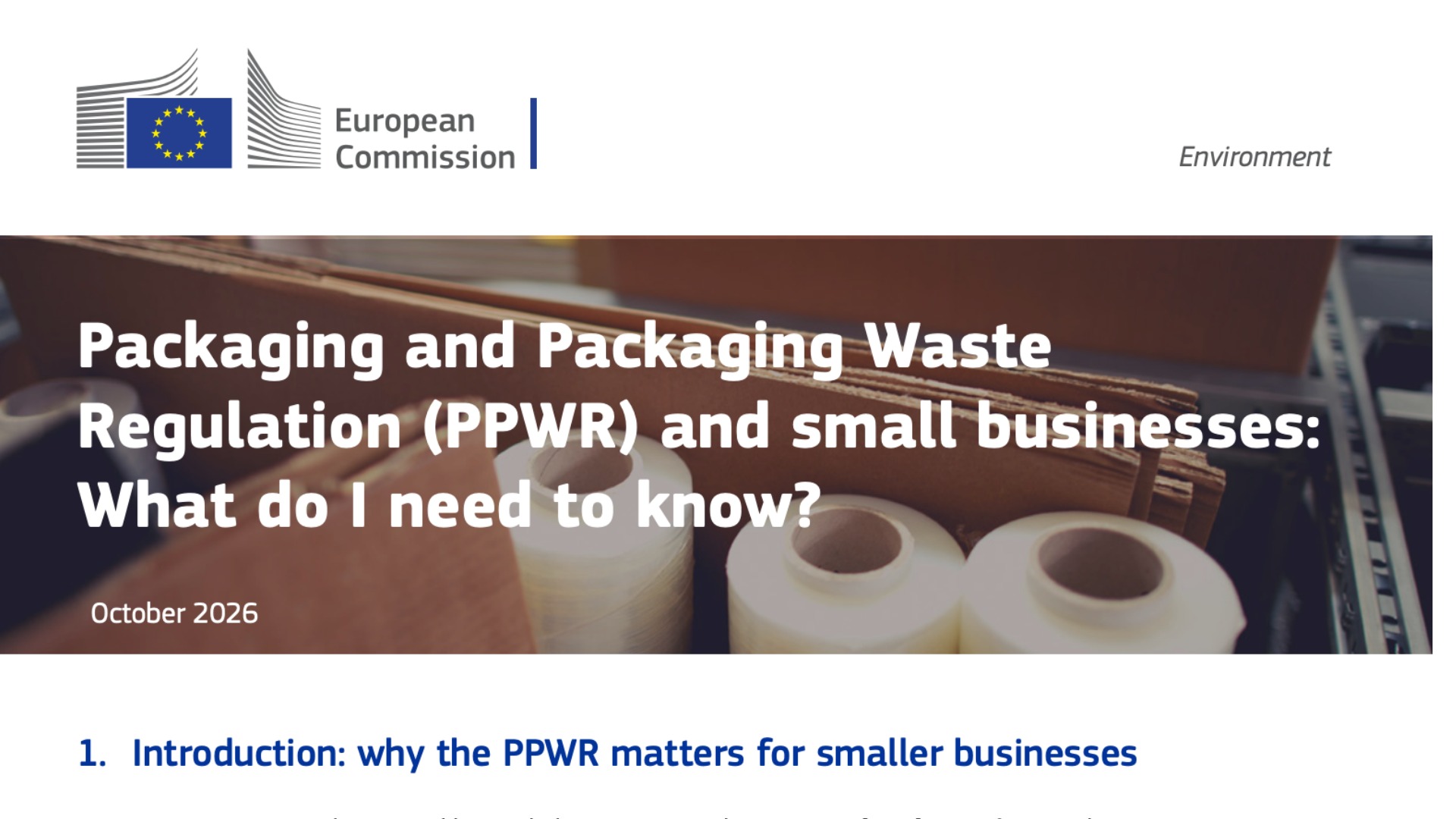
On 19 October 2026, the European Commission published a new four-page factsheet titled Packaging and Packaging Waste Regulation (PPWR) and small businesses: What do I need to know?
The document provides practical explanations of the obligations that already apply under Regulation (EU) 2025/40, as well as exemptions and upcoming requirements affecting smaller businesses.
For companies trying to implement the PPWR, the factsheet is particularly useful because it addresses some of the questions that arise when translating legislation into business operations.
It clarifies what businesses need to do now, how to identify their responsibilities, and when certain exemptions may apply.
Read the official European Commission factsheet (October 2026)
1. What PPWR requirements apply to small businesses now?
The PPWR generally started applying on 12 August 2026, but many requirements will be introduced progressively over the coming years.
The new Commission factsheet explains that, at this stage, businesses acting as manufacturers or importers must focus on a limited set of applicable conformity and traceability requirements.
One particularly useful clarification concerns the EU Declaration of Conformity (DoC).
According to page 2 of the factsheet, the PPWR requirements currently covered by the declaration concern substances of concern:
The concentration limits for lead, cadmium, mercury and hexavalent chromium.
The PFAS restrictions applicable to food-contact packaging.
The heavy-metal limits existed under the previous Packaging and Packaging Waste Directive. The Commission therefore identifies the PFAS restrictions as the principal new requirement in this area.
What businesses can do: Review existing packaging conformity documentation against the requirements currently applicable, while keeping a separate implementation plan for requirements that will apply later.
This distinction matters because a business should not treat every future PPWR obligation as already applicable—or assume that today's conformity assessment will never need to be updated.
2. Packaging suppliers must provide the information needed for compliance
The factsheet also addresses a common challenge for brands and companies purchasing packaging from third parties.
Under the PPWR, a business can be classified as the manufacturer of packaging even when another company physically produces it.
But that does not mean the brand owner must generate all supporting technical information independently.
The Commission points directly to Article 16 of the PPWR, under which packaging suppliers must provide the information and documentation necessary for manufacturers to demonstrate compliance.
How businesses can use this clarification:
If your company is responsible for a packaging Declaration of Conformity, identify which supporting information must come from each supplier.
Request relevant technical specifications, material information, testing evidence and other documentation necessary to support the applicable requirements.
This creates a clearer basis for supplier communication and helps distinguish between responsibility for issuing the declaration and responsibility for supplying the underlying evidence.
3. The Commission clarifies traceability for packaging already produced
Another practical clarification concerns manufacturer identification and traceability.
The PPWR establishes requirements for identifying packaging and linking it to the responsible manufacturer.
However, the Commission explains that packaging already produced without the required markings does not automatically need to be repackaged or destroyed.
Under the circumstances described in the factsheet, the necessary information may instead be provided through accompanying documents or digital means, provided that the packaging can be connected to the manufacturer and its Declaration of Conformity.
This could be particularly relevant to businesses managing existing packaging inventories.
What businesses can do: Check whether their existing documentation establishes reliable traceability between packaging, manufacturer identification and conformity records.
This clarification should not be interpreted as a general exemption from traceability requirements for future packaging production.
4. Are small businesses exempt from PPWR manufacturer or EPR obligations?
The Commission explains two important conditional exemptions for microenterprises.
Exemption from certain manufacturer obligations
Where a qualifying microenterprise has packaging manufactured under its name or trademark, and the supplier or physical manufacturer is established within the EU, the supplier may become the manufacturer responsible for the relevant PPWR obligations.
That includes preparing the Declaration of Conformity and ensuring the required identification and traceability.
Exemption from certain EPR obligations
The factsheet separately explains that qualifying microenterprises may benefit from an exemption from producer-related EPR obligations when the packaging-material supplier is established in the same Member State, subject to the conditions of the Regulation.
These are two distinct exemptions with different eligibility conditions.
Businesses should not assume that being a small company, purchasing packaging from a supplier, or placing low quantities on the market automatically removes all PPWR or EPR obligations.
The factsheet also emphasises the difference between:
A manufacturer, responsible for packaging conformity under the applicable PPWR provisions.
A producer, responsible for Extended Producer Responsibility, including the financing of packaging waste management.
A company may need to assess both roles separately.
5. What does the new guide say about EPR authorised representatives?
The Commission also addresses the obligation for certain producers to appoint an authorised representative in another EU Member State.
The factsheet confirms that the Commission has proposed suspending this requirement to reduce administrative burdens.
However, the proposal was still under negotiation when the guide was published.
Since then, on 21 October 2026, the Council adopted its negotiating position, proposing relief for EU-established producers placing less than one tonne of packaging annually on the market of another Member State.
This is not yet a generally applicable exemption from EPR registration or other producer responsibilities.
For a detailed analysis of the separate legislative proposals and their status, read our recent PPWR Academy article:
EU EPR Registration Exemption 2026: What SMEs Need to Know
6. What other PPWR requirements should small businesses prepare for?
The Commission also identifies several requirements that will become applicable in later phases, including:
Packaging recyclability.
Minimum recycled content in plastic packaging.
Packaging minimisation and labelling.
Restrictions on certain single-use packaging.
Packaging reuse and refill obligations.
Some of these requirements provide exemptions or lighter obligations for smaller businesses.
For example, the factsheet identifies microenterprise exemptions concerning certain reuse targets and takeaway reuse-offer obligations.
It also mentions more proportionate EPR reporting for businesses placing less than 1,000 kg of packaging on the market annually.
Lighter reporting is not the same as a complete exemption from EPR registration or financial obligations.
Businesses should therefore distinguish between exemptions, reduced administrative requirements and obligations that remain applicable.
7. How should businesses use the new Commission factsheet?
The most valuable use of the document is as a starting point for reviewing an organisation's current PPWR implementation.
We recommend five practical actions:
First, identify your roles. Determine whether your company acts as a manufacturer, importer, producer or another economic operator for each relevant packaging flow.
Second, check existing conformity documentation. Review the applicable substance restrictions and the supporting evidence for packaging currently placed on the EU market.
Third, contact your packaging suppliers. Clarify who is responsible for providing technical information and how that information will be maintained.
Fourth, assess potential exemptions carefully. Determine whether your business meets the applicable microenterprise criteria and the additional conditions for each exemption.
Fifth, create a forward-looking compliance plan. Separate obligations already applicable from those requiring preparation for future deadlines.
The objective is to move from general awareness of the Regulation to a documented understanding of what applies to your business.
Frequently asked questions
When did the European Commission publish its PPWR small business guide?
The Commission's Directorate-General for Environment published the factsheet on 19 October 2026. It is available through the Publications Office of the European Union.
Is the October 2026 factsheet a change to the PPWR?
No. The factsheet explains existing requirements, exemptions and planned developments. It does not itself amend Regulation (EU) 2025/40.
Does the guide exempt all small businesses from PPWR compliance?
No. Certain conditional exemptions apply to qualifying microenterprises, and some lighter requirements apply to smaller businesses. Eligibility must be assessed against the specific provisions of the Regulation.
Can a company rely on its packaging supplier for compliance documentation?
The PPWR requires suppliers to provide the necessary information and documentation to manufacturers. The allocation of responsibility for conformity depends on the relevant economic-operator roles.
From guidance to implementation
The Commission's October 2026 factsheet offers businesses a practical reference for reviewing PPWR responsibilities.
But understanding the guidance is only the beginning.
At PPWR Academy, we focus on translating regulatory obligations into practical compliance activities, including identifying responsibilities, collecting supplier information and maintaining the documentation needed to demonstrate conformity.
Join our upcoming webinar:
PPWR Unpacked: From Rules to Reality
Discover how to connect regulatory requirements with the operational processes needed to manage compliance.
Register for our free PPWR webinar
Official sources
European Commission — Packaging and Packaging Waste Regulation (PPWR) and small businesses: What do I need to know? — 19 October 2026.
European Commission — Extended Producer Responsibility for Packaging for Small Businesses.
Council of the EU — Simplification of requirements for small packaging producers — 21 October 2026.
Regulatory status: 29 October 2026. This article is intended for educational purposes and does not constitute legal advice. Businesses should assess the applicable PPWR provisions, relevant national requirements and their own circumstances before making compliance decisions.