PPWR Reusable Packaging: European Commission Clarifies Labelling, Rotation Tracking and Existing Reuse Systems
On 29 October 2026, the European Commission clarified three important PPWR questions: Can existing reusable packaging remain in circulation? Must every reuse cycle be tracked individually? Can established reuse systems continue operating? We explain what has been confirmed, what remains uncertain and what businesses should do next.
PPWR Reusable Packaging: European Commission Clarifies Labelling, Rotation Tracking and Existing Reuse Systems
Do businesses need to relabel millions of reusable bottles, crates and kegs under the EU Packaging and Packaging Waste Regulation (PPWR)? Must every reuse cycle be tracked individually? And can existing reuse systems continue operating?
On 29 October 2026, the European Commission responded to three important questions about the treatment of existing reusable packaging under Regulation (EU) 2025/40.
The response, issued by Commissioner Jessika Roswall on behalf of the European Commission, provides welcome clarification for businesses that already operate reusable packaging systems.
It also highlights areas where technical implementation rules are still being developed.
For beverage producers, packaging manufacturers, logistics providers, retailers and reusable packaging pool operators, these distinctions could affect future labelling decisions, investment in tracking systems and compliance documentation.
Here is what the Commission confirmed, what remains unresolved and what businesses should prepare for.
Why did the European Commission issue this clarification?
Reusable packaging is not a new concept.
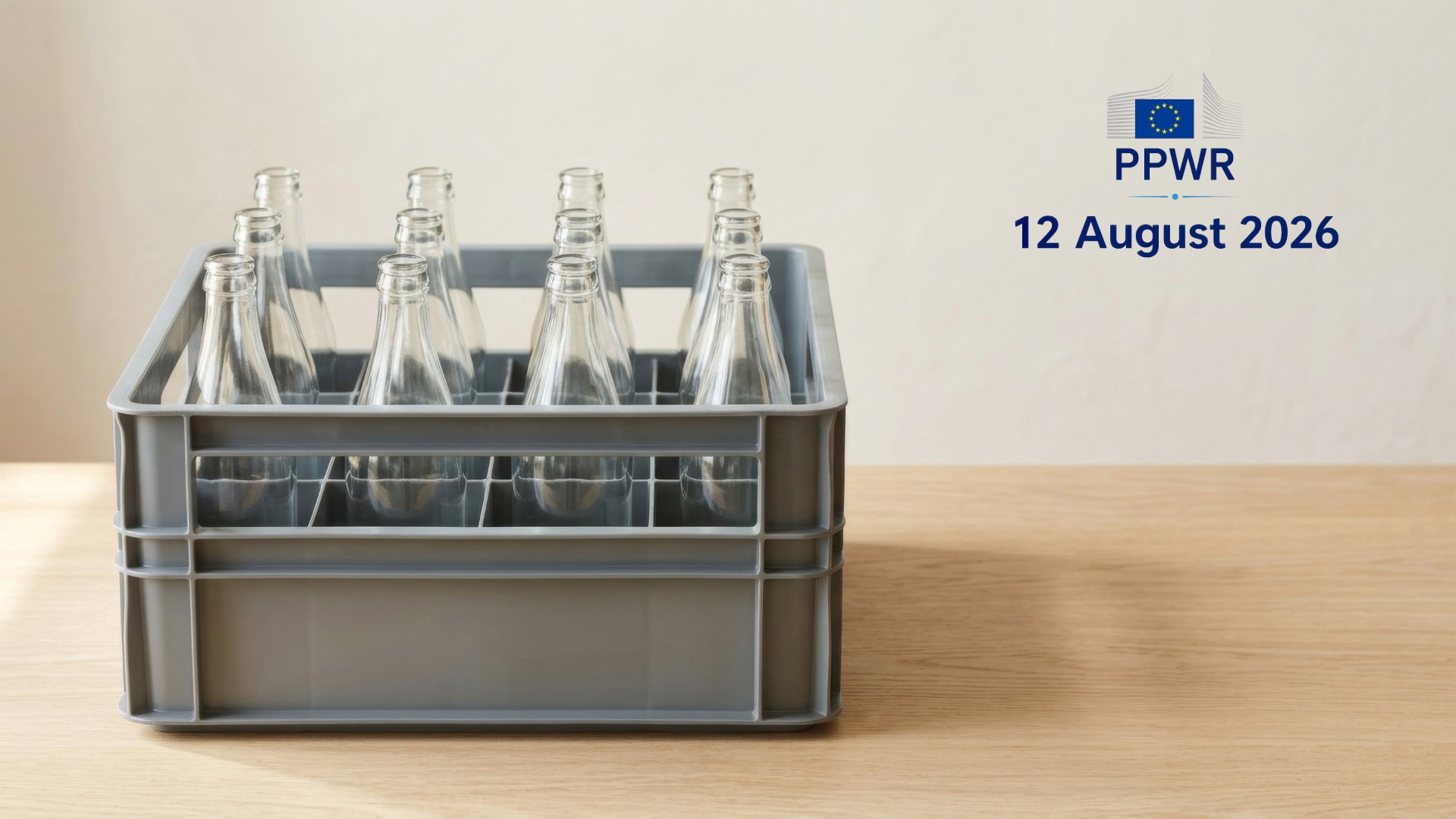
Across Europe, glass bottles, plastic crates, beverage kegs, industrial containers and returnable transport packaging have circulated through established reuse systems for decades.
Many of these packaging formats are designed to complete numerous trips before being retired.
However, the PPWR introduces new requirements concerning reusable packaging, including labelling, information provision, reuse performance and the operation of reuse systems.
This creates practical questions for companies managing large packaging fleets.
Would businesses need to replace or redesign perfectly functional packaging?
Would they need to implement individual identification and tracking for millions of bottles or crates?
Would existing reuse systems need to be redesigned to demonstrate compliance?
These concerns were raised by MEP Marcin Sypniewski in written parliamentary question E-003393/2026, submitted on 31 August 2026.
The European Commission answered on 29 October 2026.
The response addresses three distinct issues.
1. Can existing reusable packaging remain in circulation without being redesigned?
The Commission's answer: Yes, provided the issue is redesign solely to meet the new labelling requirements.
The Commission confirmed that reusable packaging placed on the market before the new labelling requirements become applicable may continue circulating without having to be redesigned solely to satisfy those requirements.
This is particularly important for companies using returnable packaging with a long operational life.
Consider a beverage company operating a fleet of reusable glass bottles.
The bottles may already have established collection, washing, inspection and refilling processes. They may remain functional through many reuse cycles.
Replacing these bottles solely to accommodate a new harmonised label could create substantial costs and additional waste.
The Commission's response provides reassurance that existing reusable packaging is not automatically required to undergo such redesign simply because the new labelling requirements are introduced.
What does this mean for businesses?
Companies should distinguish between:
Reusable packaging already circulating within established systems.
New reusable packaging placed on the market after the relevant labelling requirements become applicable.
Other PPWR obligations that may apply independently of the new labels.
Importantly, the clarification concerns redesign for labelling. It should not be interpreted as a blanket exemption from the PPWR.
The response also does not provide detailed instructions for every category of packaging or reconcile all previously published transitional guidance.
Businesses should therefore examine the specific requirements applicable to their packaging before making major compliance or investment decisions.
When will the labelling requirements apply?
The Commission's 29 October answer refers to a 24-month period following the entry into force of the relevant implementing act, which is still being prepared.
There is an important legal distinction worth noting.
Article 12(1) of the PPWR establishes a 24-month period for harmonised material-composition labelling, subject to the relevant minimum application date.
Article 12(2), which specifically addresses labels identifying packaging as reusable, establishes an application date of 12 February 2029 or 30 months after the relevant implementing act enters into force, whichever is later.
Businesses should distinguish these provisions rather than assume that all packaging labels share the same deadline.
The final application timetable will depend on the adoption and entry into force of the relevant implementing act.
For more background, read our earlier article: PPWR Packaging Labelling Requirements: What Businesses Should Prepare Now for 2028.
2. Can businesses use statistical data to calculate reuse rotations instead of tracking each item?
The Commission's answer: Further clarification is still needed.
The parliamentary question asked whether businesses could demonstrate the number of reuse cycles using reliable statistical and operational data instead of tracking every individual packaging item.
This is a significant practical issue.
A company using hundreds of thousands of reusable bottles may have comprehensive records of packaging movements, filling operations and returns without being able to identify every individual bottle throughout its operational life.
Introducing individual tracking could require additional equipment, changes to packaging design, software integration and investments in data collection infrastructure.
What has the Commission confirmed?
In its 29 October response, the Commission stated that the forthcoming implementing act on labelling, adopted pursuant to Article 12(1), will provide guidance on:
The data operators must use to calculate the number of rotations.
The methodology to be followed when calculating those rotations.
The Commission did not expressly confirm that statistical or operational data alone will be sufficient in every case.
This is an important distinction.
Article 12(2) of the PPWR already refers to the possibility of an average estimation where calculating trips and rotations is not feasible.
Annex VI also contains provisions addressing reporting data and average estimates in circumstances where direct calculations cannot be performed.
However, these provisions should not be interpreted as unrestricted permission to substitute estimates for tracking in every reuse system.
The detailed requirements and accepted methodologies still need to be considered.
What could this mean operationally?
Consider a company managing a reusable crate pool across several warehouses and distribution partners.
The company may already collect information about:
The number of crates entering the reuse pool.
Crates issued to customers or distribution centres.
Returned crates.
Cleaning, inspection and reconditioning activities.
Damaged or rejected crates.
Packaging units removed from circulation.
These records may provide a valuable basis for assessing reuse performance.
But whether a particular calculation method meets all applicable PPWR requirements will depend on the relevant provisions and forthcoming technical clarification.
Our recommendation: Businesses should review the reliability of their current reuse data before investing in expensive item-level tracking solutions whose final regulatory specifications have not yet been established.
The objective is to identify existing data capabilities, understand gaps and prepare for the final methodology.
3. Can existing reuse systems continue operating without additional compliance work?
The Commission's answer: Yes, existing systems may continue—but only if they meet the applicable PPWR requirements.
The Commission explicitly recognised that existing reuse systems can be used to comply with the Regulation.
However, their continued operation is conditional on compliance with Article 26 and Annex VI.
This means an established reuse system is not automatically considered compliant simply because it has operated successfully for many years.
What does Article 26 require?
Article 26 addresses obligations relating to reusable packaging.
It requires relevant economic operators making reusable packaging available for the first time in a Member State to ensure an appropriate reuse system is in place.
Existing reuse systems can fulfil this requirement.
However, the system must meet the requirements laid down in Annex VI.
Article 26(2) also requires a description of system compliance as part of the technical documentation for reusable packaging, supported by relevant written confirmations from system participants.
This is particularly important because the parliamentary question asked whether existing systems could operate without revising documentation or demonstrating compliance.
The Commission did not grant that exemption.
What does Annex VI mean in practice?
Annex VI establishes requirements for reuse systems, including provisions concerning:
System governance and participant responsibilities.
Rules for packaging collection, handling and storage.
Packaging reconditioning and redistribution.
Return arrangements and system operation.
Information on reuse performance and reporting.
Procedures for packaging that can no longer be reused.
Certain exceptions apply depending on the structure of the reuse system, including provisions for open-loop systems.
The relevant requirements must therefore be assessed according to how the particular reuse system operates.
For example, a company using returnable transport crates through a closed-loop pooling arrangement should identify the system operator, relevant participants, collection arrangements, reconditioning procedures and available compliance records.
Even where the system is functioning effectively, those processes may need to be documented or reviewed against Annex VI.
The key message: An existing reuse system can be part of the solution, but its history of operation does not replace the need to demonstrate applicable compliance.
4. What is now confirmed, and what remains uncertain?
The Commission's response provides useful clarity, but it does not resolve every technical question.
Question | Current position |
|---|---|
Can existing reusable packaging remain in circulation? | Yes, the Commission confirms that packaging placed on the market before the new labelling requirements apply may continue without redesign solely for those requirements. |
Must every individual item be tracked? | The Commission has not provided a definitive answer. Further data and methodology guidance is expected. |
Can statistical data be used for rotations? | The PPWR recognises average estimates in specified circumstances, but the Commission has not confirmed that statistical data alone always suffice. |
Can established reuse systems continue? | Yes, provided they meet applicable Article 26 and Annex VI requirements. |
Are existing systems exempt from compliance documentation? | No general exemption was confirmed. |
Are all technical requirements finalised? | No. Relevant implementing measures remain under development. |
This distinction between confirmed requirements and pending technical detail is essential for sound compliance planning.
5. Five practical steps businesses should take now
The Commission's clarification should help businesses make better decisions, not postpone all preparation until the final implementing acts are published.
Step 1: Map existing reusable packaging
Identify reusable packaging formats across your operations.
Include relevant bottles, crates, pallets, kegs, drums, trays and other returnable packaging.
Record the materials, suppliers, packaging formats, reuse arrangements and available documentation.
Step 2: Review planned packaging redesigns
Identify packaging scheduled for redesign or replacement.
Separate changes required for product safety, operational performance or existing compliance obligations from changes proposed solely to anticipate future harmonised labels.
Avoid committing to expensive changes based on specifications that are not yet final.
Step 3: Evaluate existing rotation data
Review the information already available through warehouse management, ERP systems, return processes, cleaning operations and packaging pool records.
Determine what can be measured reliably, what requires estimation and where data gaps exist.
Do not assume that individual item-level tracking is mandatory in every case—or that statistical estimates will always be accepted.
Step 4: Assess existing reuse systems against Annex VI
Review your reuse system's governance, operating rules and supporting documentation.
Confirm who is responsible for collecting, reconditioning and redistributing packaging.
Determine which Annex VI requirements apply to your system, including any relevant exceptions.
Step 5: Monitor forthcoming implementing measures
Track the development of the EU's harmonised labelling specifications and guidance on rotation calculations.
Assign responsibility within your organisation for assessing new requirements as they are adopted.
This will help prevent unnecessary investment while ensuring that technical and compliance teams remain prepared.
Frequently asked questions about PPWR reusable packaging
Does PPWR require existing reusable bottles to be relabelled?
The Commission's 29 October 2026 answer confirms that reusable packaging placed on the market before the new labelling requirements apply may remain in circulation without redesign solely to comply with those requirements. The statement does not establish a blanket exemption from every other PPWR obligation.
When will PPWR reusable packaging labels become mandatory?
Article 12(2) provides for 12 February 2029 or 30 months after the relevant implementing act enters into force, whichever is later. The Commission's October response refers to 24 months in discussing labelling generally, but the specific Article 12(2) provision must also be considered.
Is individual QR-code tracking mandatory for every reusable bottle or crate?
The requirements depend on the packaging and reuse system. Article 12 contains specific labelling and digital-information obligations, as well as exceptions. The Commission has not yet confirmed a universally applicable method for calculating rotations.
Can businesses use estimated reuse cycles?
The PPWR recognises average estimates in specified situations where calculation is not feasible. However, the Commission's October response does not establish that statistical data alone will always be sufficient. Further methodology guidance is expected.
Do existing reuse systems automatically comply with the PPWR?
No. Existing systems may continue operating, but must meet the applicable requirements of Article 26 and Annex VI.
Do established reuse systems need compliance documentation?
Article 26(2) addresses documentation demonstrating reuse-system compliance. The Commission has not announced a general exemption for established systems.
The bigger picture: Prepare your systems, not just your labels
The Commission's latest clarification is an important reminder that PPWR compliance is not simply about redesigning packaging or introducing new labels.
It is also about understanding how packaging moves through the supply chain, how reuse systems operate and how businesses can demonstrate compliance using reliable information.
For companies with established reusable packaging systems, much of the necessary operational knowledge may already exist.
The challenge is identifying which records and processes are relevant, evaluating their reliability and understanding what additional evidence the Regulation requires.
The Commission's October response offers greater certainty in some areas while acknowledging that further technical guidance is still needed.
That makes a structured, evidence-based approach particularly valuable.
Turn PPWR requirements into practical action
At PPWR Academy, we help businesses understand regulatory developments and translate them into practical compliance decisions.
Join our free webinar, PPWR Unpacked: From Rules to Reality, where we explore PPWR responsibilities, documentation, supplier information and operational implementation.
Register for the free PPWR Academy webinar
Official sources and further reading
Regulation (EU) 2025/40 — Packaging and Packaging Waste Regulation, particularly Articles 11, 12, 26 and 27 and Annex VI.
European Commission — Guidance on the PPWR, 10 June 2026, particularly the sections addressing reusable packaging and harmonised labelling.
PPWR Academy — Packaging Labelling Requirements: What Businesses Should Prepare Now for 2028.
Regulatory information reviewed as of 3 November 2026. This article is intended for educational purposes and does not constitute legal advice. The Regulation and any applicable EU implementing measures remain the primary legal references.